
Tips to win on 5×5
The 5×5 board has just five lines each way. A game takes a few minutes, which makes it perfect practice for beginners. Here are five tips to help you start beating the AI on 5×5.
1. Play your first stone in the middle
The more liberties a stone has, the harder it is to capture (see “The four rules in detail”). A stone in the middle of the board has four, but a stone on the edge has three and a stone in the corner only two. On a board as small as 5×5 every stone is close to an edge, and stones played on the edge are surrounded in no time.
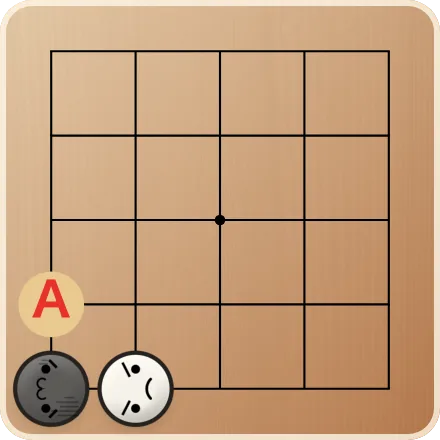
If you are Black, start at the very center of the board (tengen). A stone in the middle can grow in every direction. As White, too, play as close to the center as you can.
2. Keep your stones connected
Stones of the same color that touch up, down, left or right merge into one group and share their liberties. A single stone in the middle has four liberties, but two connected stones have six and three in a line have eight. Connected stones are strong stones that are hard to capture. In Punigo, connected stones merge into one shape, so you can see at a glance whether your stones are connected.
When your stones are scattered, they can be surrounded and captured one at a time. If you are not sure where to play, play where you connect to your own stones.
3. Never miss an atari
The 5×5 board is small, so the fighting starts right away. After every move your opponent makes, check whether any stone is in atari. If an opponent stone is in atari, capture it. If one of yours is, run, or save it by capturing a neighboring opponent stone. Stones in atari look worried, so the faces help you notice. “Capturing and escaping” explains capturing and escaping with diagrams.
4. Cut your opponent's stones apart
If connected stones are strong, keeping your opponent's stones from connecting matters just as much. Play between their stones to cut them apart, and your opponent has to defend two small groups instead of one.
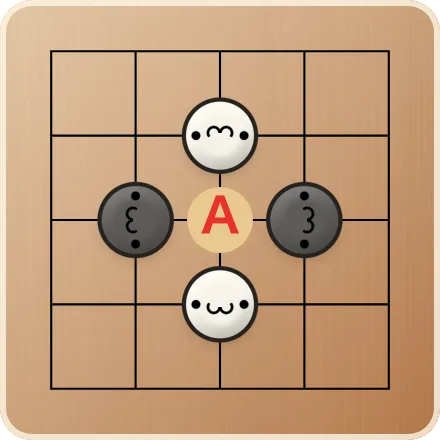
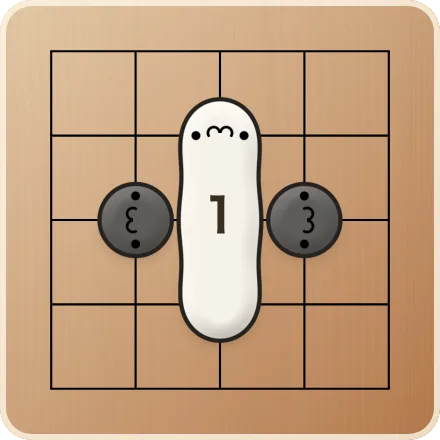
The point where you want to connect is exactly where your opponent wants to cut. Whoever plays such a point first gains from it.
5. At the end, leave two eyes and pass
Toward the end of the game, fill the area you have surrounded with your own stones. When you do, always leave two separate empty points (two eyes) inside your group. With only one eye left, even a big group can be captured whole.
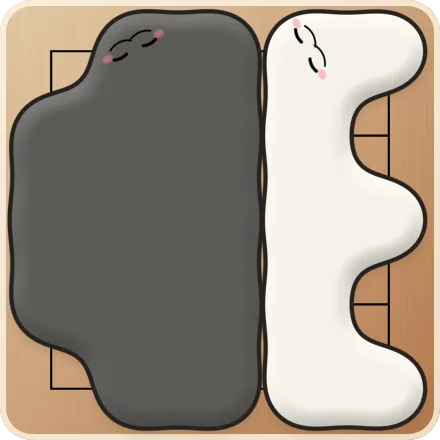
For more on eyes, read “Living and dead stones”.
When you start winning
Each time you beat the AI on 5×5, the “Next game” offers a slightly stronger opponent. Once you beat 20 kyu on 5×5, move on to 6×6 and 7×7. Bigger boards call for some new ideas on top of these tips. → Tips for 7×7 and 9×9