
Living and dead stones (all about eyes)
Even a big group of stones can be captured in the end. On the other hand, some groups can never be captured, however tightly they are surrounded. What makes the difference is eyes.
What is an eye?
An eye is an empty point surrounded only by your own stones. A stone placed there by your opponent would have no liberties, so normally your opponent cannot play in your eye (it is one of the illegal points in Rule 2). But if the stones around an eye are split into separate groups, it may only look like an eye, and those stones can still be captured.
One eye is not enough
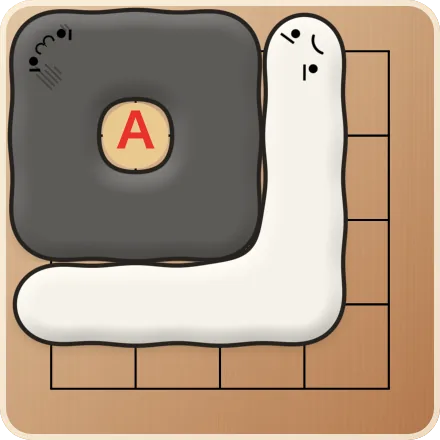
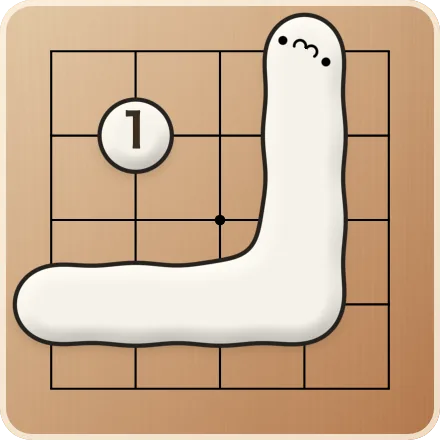
A group with only one eye can be captured. Once all its outside liberties are filled, the opponent plays inside the eye. That move is allowed because it fills the group's last liberty and captures it.
With two eyes, you can never be captured
With two eyes, everything changes. A white stone placed at A would have no liberties, and Black still has its liberty at B, so the white stone would not capture anything. So White cannot play at A. The same goes for B. A group with two eyes can never be captured, no matter how it is surrounded. It is “alive”.
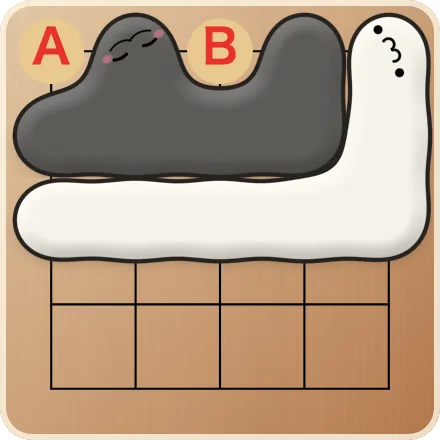
In Punigo, a living group has a big happy smile and pink cheeks.
Why eyes matter when you count stones
At the end of a Punigo game you count the stones on the board. Empty points you have surrounded do not count. So as the game nears its end, you need to fill your territory (the area your stones surround) with your own stones.
The trap is filling too much. If you fill your own eyes, your group is left with one eye, and your opponent can capture all of it.
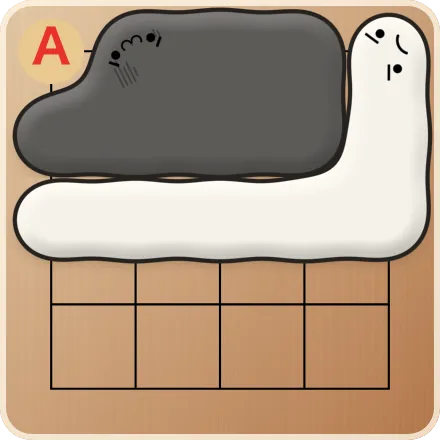
The basic rule for the end of the game: leave two separate eyes, and fill the rest of your territory. Two empty points next to each other only count as one eye, so be careful: the opponent can play on one of them, because that stone still has the other point as a liberty. Each eye beyond two costs you one stone, so fill the points you safely can, but always keep two separate eyes.
For a big eye, the middle point is vital
When a group has no other eye and the empty space inside it is larger, such as three connected points, life and death depends on who plays the middle point (the vital point) first. If you play it first, the space splits into two separate eyes and you live. If your opponent plays it first, you cannot make two eyes.
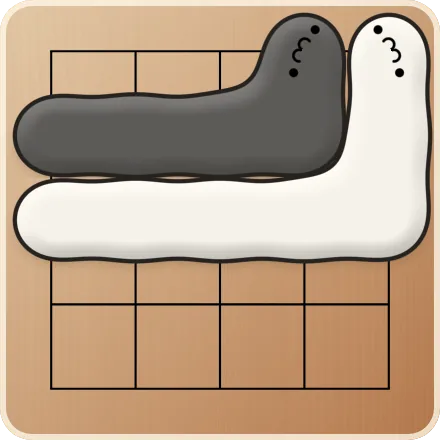
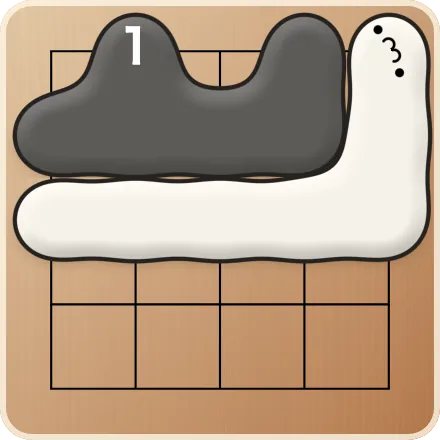
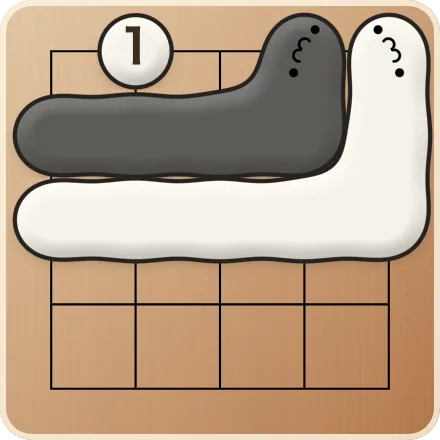
The same holds when the three points bend around a corner: the vital point is the one at the bend. When you want to capture an opponent's group, do the opposite: play the vital point so it cannot make two eyes. Problem 8 and Problem 10 let you practice making and destroying eyes.
Summary
- An empty point surrounded only by your stones is an eye.
- A group with one eye is captured once its outside liberties are filled.
- A group with two eyes can never be captured. It is alive.
- When you fill your territory at the end, always keep two separate eyes.
- For three connected empty points, the middle point is vital.